
In his book “The Four Pillars of Falsehood and the Public of Republic”, Aridaman Jit Singh in detailed accounts his work and experience from 1983 to 2003 as a Senior Police Officer in India’s Central Police Organisation. The book is an important contribution to the history of how public order and counter insurgency laws were enforced in India over twenty years. He writes as someone man who was on the front line as police and army operations took place to counter insurgency and maintain public order. His work took him to the “hot spots” in a number of the States that make up India in the post-colonial era. As well as a Commander in front line operations during his career he held appointments in policy making, planning, and liaison with agencies and specialist units that made up the law enforcement force established by successive State and Federal governments. This a man whose work engaged him with Politicians, Sate and Federal Police Officers, the Military and the Judiciary and gave him.
His book is one man’s historical record of events widely reported in the media at the time they occurred and events that were not reported in the media. In one sense it is the history behind the news stories and events that policy decision makers decided that in the wider interests of national security or public order would not be made public. It is a history of what he saw, his knowledge and understanding of events as they unfolded together with the aftermath of those events. The history records what was not available to the media or kept from the media, so the media did not have the full picture and a result nor did the public.
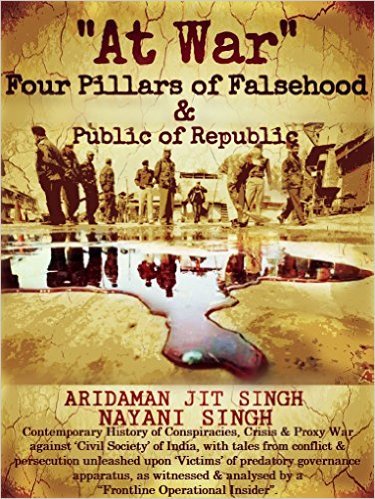
As soon as the book is opened it is clear to the reader that the author is a man of high principle, loyal in his duty to his country and colleagues but not a man to let pass by or cover or up an abuse or excess in the enforcement of laws and ordinances or a man afraid to stand up and make his views known to those senior to him. The narrative on the inside fly cover of his book sets the scene for the pages that follow.
“His practical field experience and exposure with the highest officers in the country acquainted him with the pitfalls of exiting governance apparatus and its challenges to the common man. After 20 years of mandatory service he resigned from government for facing limitations to his working on serious issues of corruption and extra judicial killings”.
The law enforcement agencies – Sate and Federal Police and the Army as well as specialist units established within umbrella organisations – had wide ranging statutory powers at their disposal to control public order and counter insurgency threats and activities. The author builds a record of how those powers came to be abused and used in an excessive way. Incidents and events are recorded, in detail, of false evidence that led to false arrest and charges, resulting in false imprisonment; examples are recorded of extra judicial killings.
The history of many countries shows that corruption can often prosper alongside the misuse of power including the exercise of power to protect public and national security. Corruption in the enforcement agencies and amongst government officers and politicians is a constant thread in the history the author presents to the reader. One chilling example is the misuse of cash incentives to field personnel who too often presented innocent individuals as insurgents and who put securing a cash incentive for a conviction ahead of ensuring charges were based on evidence and that fair process was followed; matters that are fundamental in the discharge of an officer’s duty when investigating and enforcing the law. The practice was so widespread that the author considers that such payments became an expected part of the remuneration of those working in the enforcement units.
Further examples are given of corruption and malpractice throughout the administrative and judicial structure empowered to fight the threat to public order from insurgents. A history of wide scale abuse of human rights and due process emerges all of which was discharged in the interest of public order and national security. The abuse and excess in the use of the law was applied not only to true insurgents committed to use force to pursue political goals but also to protest groups whose intent was to raise peaceful objections to a government policy. The result was that peaceful protesters could find themselves branded as insurgents and free speech treated as incitement.
The history of the formidable obstacles the author faced in trying to expose corruption, miscarriages of justice and to bring the abuse to the attention of senior policy and decision makers and the judiciary identifies a systemic failure in policy making, law enforcement and accountability at all levels. The obstacles ultimately led him to leave the Police Force and campaign for civil rights and accountability for the abuse of the law.
In 1983-2003 the arsenal of laws at the disposal of the law enforcement agencies in India was formidable. The arsenal remains available today. The laws are seen as draconian by many jurists and human rights campaigners and when combined with the author’s history as to how they were used over a twenty year period, with no workable and effective checks and balances on the exercise of power in place, they cast a shadow and for many a dark cloud, over civil and human rights in India, rights that a democracy should strive to cultivate and protect. The origin of India’s public order and security laws is important to understand.
A strong theme in the book is how a colonial law passed in 1942, The Armed Forces Special Powers Ordinance of 1942 (AFSPA) to provide powers to control the Quit India Movement, portrayed at that time as an essential tool to manage a political movement for independence and brand it as an insurgency. After independence AFSPA continued to be the legal foundation in India to control political movements opposed to policies of the Federal Government or State Governments.
The provisions in the public order and insurgency laws in India are out of step with many in the international community. As early as 1991, The United Nations Human Rights Committee and some member countries openly criticised the scope and use of AFSPA arguing that it was not compatible with the Indian Constitution or internationally recognised standards on Human and Political Rights. The colonial roots of AFSPA added to the international discomfort of the laws and the manner in which they were used. In 2012 the United Nations Assembly asked India to revoke AFSPA on the basis of resentment of the law within India, particularly in relation to actions of the Police and Army in Kashmir and was in breach of International Law.
A reader of the book in 2106 from Europe or North America, particularly one who is aware that India is the world’s largest democracy by electorate and one of the oldest civilisations in the world will be shocked by the history set out. In Europe and North America investigative journalism was under way in the 1980’s and gathered pace throughout the 1990’s. Today accountability in government for law enforcement and the respect of human rights is now under close scrutiny and extensively debated in legislative bodies and in the media; the public insists that it is so.
The media in India in 1983-2003 did not expose the misuse and abuse of the law and to the contrary the author carefully shows how the media presented the campaign to protect public order and counter insurgency as a positive and essential tool to secure public safety. They did so because this was the message fed to the media and there was not a strong enough independent media base to oppose or expose the misuse of the law. Nor was there the political will to address such matters. In a democracy it is the responsibility of Government to ensure that there is in place a workable and effective structure of checks and balances in place to respect civil liberties and human rights when public order and counter insurgency and security laws are exercised. No structure is sound or effective if it is susceptible to corruption at any level. The author has demonstrated that in a democracy the media can and should play an important role in bringing to the public’s attention that abuse of power and any corruption in the course of the exercise of power to enforce laws that are by nature draconian.
At a time when terrorist attacks take place on an international scale the author’s book is not only an important contribution to history of India over a 20 year period it is a timely reminder that in fighting terrorism and insurgency, civil liberty and accountability cannot be ignored. The words of Sallust come to mind:
“Every bad precedent originated as a justifiable measure.”
Graham Simkin
London, January 2016